How the System Operates for Several Days Without Sunlight
An overview of the Energy-Efficient Operation
The Challenge : Long Sleep, Short Wake Time
The system is designed for ultra-low-power operation by maximizing time spent in deep sleep and minimizing active periods.
During normal operation, the microcontroller remains in deep sleep for extended periods—ranging from minutes to hours—consuming only a few microamps of current. This drastically reduces overall energy consumption and enables long-term operation even with limited energy sources.
A key factor in achieving high efficiency is keeping the awake time as short as possible. For wireless communication using ESP-NOW, the system requires only approximately 20–80 ms of active time. After completing the transmission, it immediately returns to deep sleep.
When controlling actuators such as latching solenoid valves, energy usage is also optimized. The system briefly generates the required 9 V supply, and the actual switching of the solenoid takes only about 15 ms. Since latching solenoids do not require continuous power to maintain their state, no additional energy is consumed after switching.
By combining long sleep intervals, ultra-short wake times, and efficient actuator control, the system achieves highly optimized energy performance suitable for energy-harvesting applications.
Maximum Runtime Without Sunlight
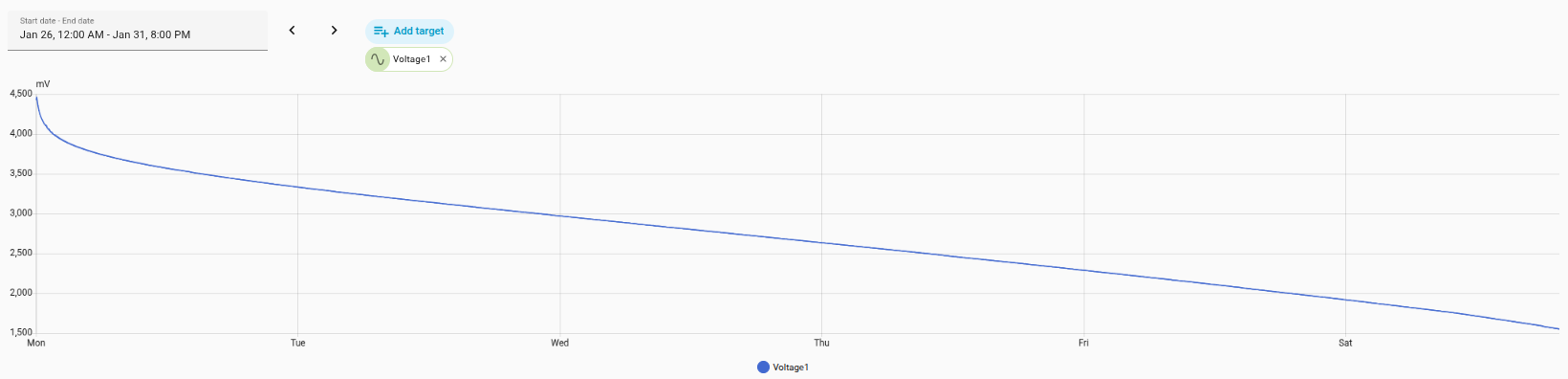
In a continuous deep sleep scenario, the system can operate for several days without sunlight. In our experiment, fully charged supercapacitors powered the ESP32-C3 via a DC/DC converter down to 1.5 V. This allowed a final wake-up and ESP-NOW transmission before shutdown. Total runtime reached nearly 6 days.
Day-Night Cycles
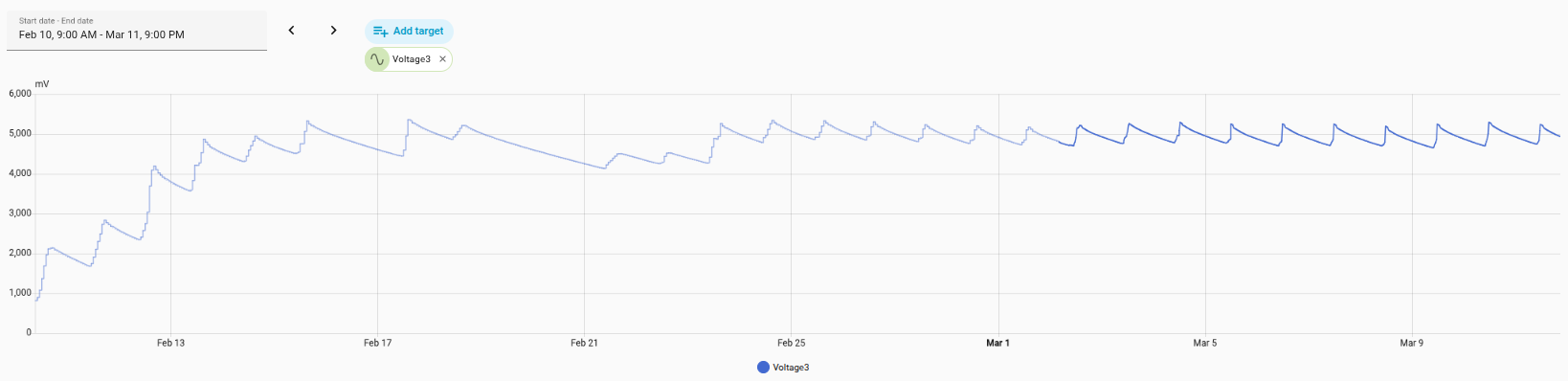
A long-term measurement shows the typical charge and discharge behavior following day–night cycles. Even under cloudy conditions, the supercapacitors are charged close to their maximum voltage levels.
In this example, the ESP32-C3 operates in continuous deep sleep mode. Between February 19 and February 20, snowfall occurred in Bratislava, covering the solar panel. As a result, the supercapacitors could not be recharged for three days.
Despite this, the voltage did not drop below 4.1 V, demonstrating the system’s robustness under unfavorable environmental conditions.
Real-World Test
In the first real-world test, a 9 V DC latching solenoid valve from Rain Bird and a DHT11 temperature and humidity sensor were connected.
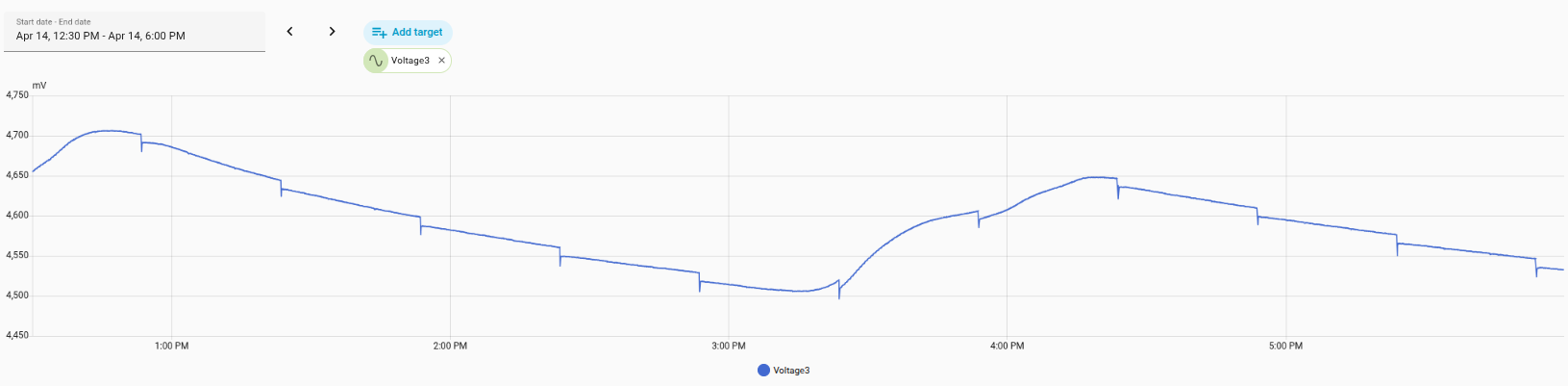
The node communicated with a receiver (XIAO ESP32-C3) every 10 minutes. Additionally, the solenoid was switched in both directions every 30 minutes within a 1-second interval.
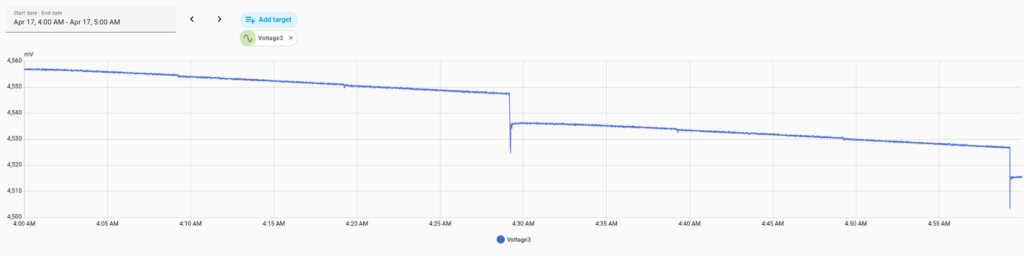
The results show the energy required for each switching event. Each time the solenoid was activated, the supercapacitor voltage dropped by approximately 11 mV, corresponding to an energy consumption of about 550 mJ at around 4.5 V.
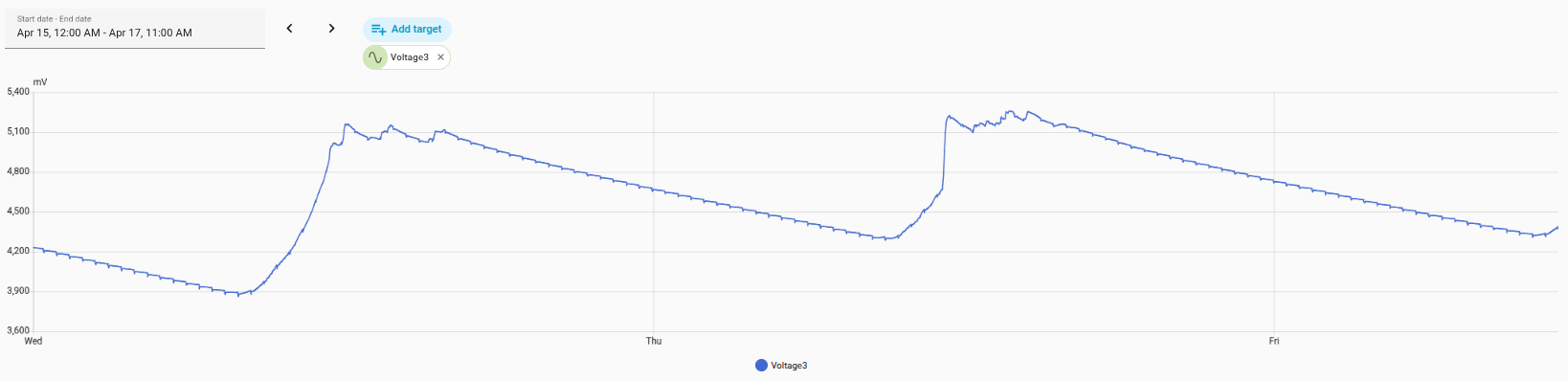
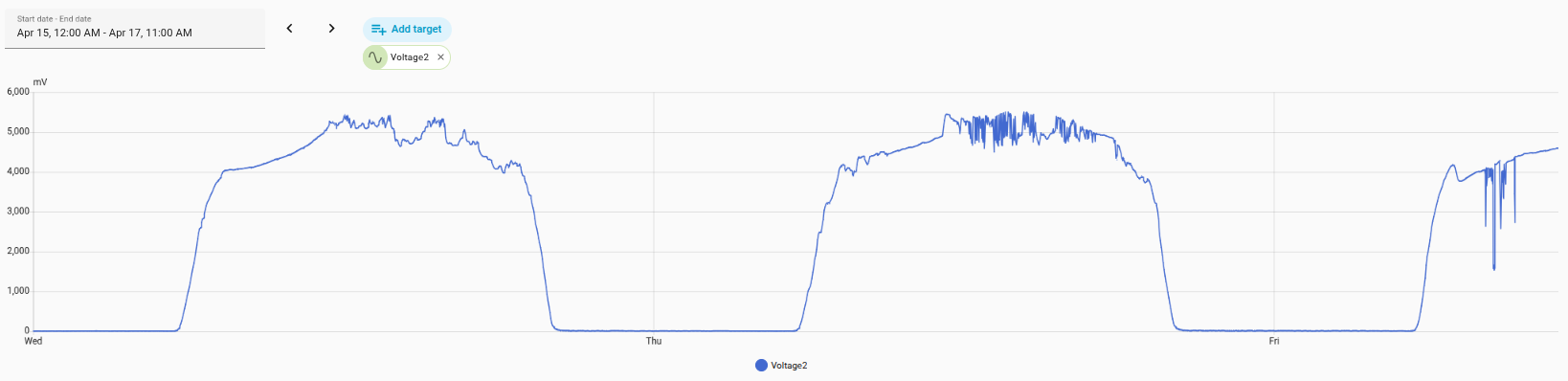
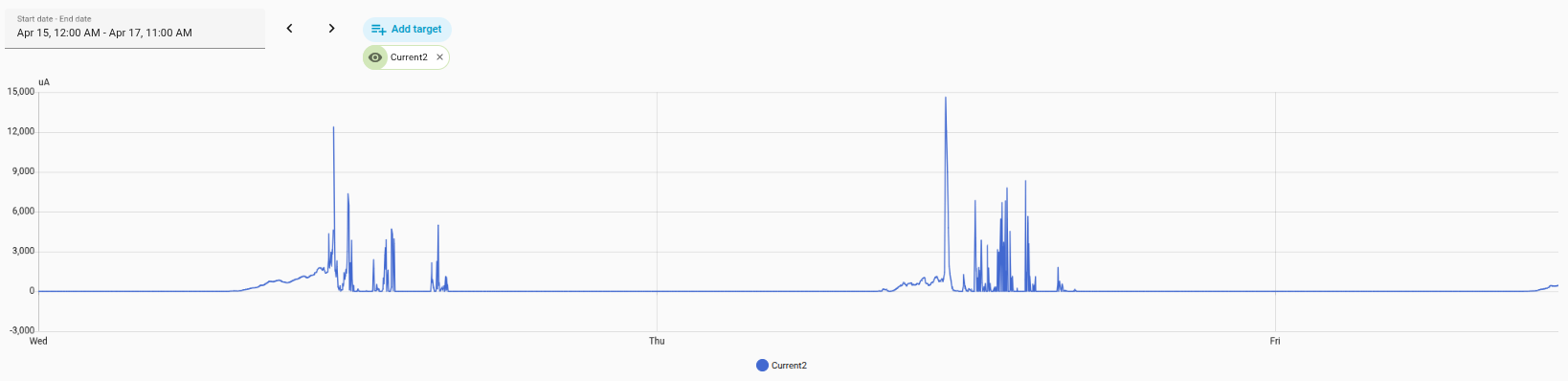
2-Day Measurement – Test results
The voltage drop over a one-day cycle is approximately 1 V. It is caused by a combination of switching events and discharge resulting from the total quiescent current of the module. By optimizing the switching schedule, the duration without charging can be significantly extended.
Voltage3: supercapacitor voltage
Voltage2: solar panel voltage
Current2: solar panel output current
For data logging, a custom-built hardware device was used to measure multiple voltage and current channels. The data samples were stored and visualized using the Home Assistant environment.